A studio flat on Borech, a 2+kk apartment on Slovanech or a detached house in Lochotín – each of these spaces requires air conditioning set up differently. The key lies in three decisions: what capacity is needed, whether to choose a split or multisplit system, and how noisy the unit can be where people sleep. The right answer always depends on the specific apartment, not on a general rule that applies equally to all spaces.
Selecting capacity based on floor area
At our company, air-conditioning capacity is stated in kilowatts of cooling output. During the survey, we calculate based on the room area, ceiling height, number and orientation of windows, and whether the room is under a roof or between other flats. A smaller bedroom or home office in a panel flat usually requires the smallest commonly available unit, whereas a glazed living room with a south-facing orientation or an attic room in a detached house needs higher capacity, even if it has a similar area on paper. Therefore, capacity is always confirmed on site – an estimate based solely on square metres without knowledge of orientation and building layout could result in under-sizing or unnecessarily over-sizing the unit.
Split or multisplit
Split means one outdoor and one indoor unit – a solution for an apartment where you want to air-condition a single room, typically a bedroom or living room. It is the cheaper and technically simpler option, which we most frequently encounter in panel buildings in Plzeň.
Multisplit It features one outdoor unit and multiple indoor units connected to a shared circuit – ideal when you want to air-condition several rooms at once without installing multiple outdoor units side by side on the façade or in the garden. In detached houses in Lochotín or Doubravka, we most often install multisplit systems for the living room, bedroom and study combined – one outdoor unit suffices, while each room operates according to its own settings.
Noise levels – what to watch out for in the bedroom
Modern indoor units operate at around 19 dB in quiet mode. 20-40 dB(A), which corresponds to a quiet whisper up to a standard fan at its lowest speed. For bedrooms, we therefore recommend units with sufficient capacity reserve so they can run in quiet mode at night without needing to operate at full power. With the outdoor unit, placement relative to neighbours' windows is crucial – especially in densely built-up areas such as the centre of Plzeň or older housing around Slovan, we arrange installation so the unit does not unnecessarily disturb anyone.
Cassette unit as an alternative
In addition to the standard wall-mounted unit, there is also a cassette variant installed directly into the suspended ceiling, with only a thin frame and grille protruding into the room. We rarely choose this for flats as it requires a suspended ceiling and higher ceilings to accommodate the pipework behind it. However, it works well in open-plan living rooms combined with kitchens, where air needs to be distributed evenly across the entire space from four sides rather than from a single point on a wall. Similarly, we install it in offices and smaller premises where a wall-mounted unit on one wall is insufficient to cover the whole room.
Flat or house – what is the difference when choosing?
In an apartment in a panel building, the main constraints are usually the location of the outdoor unit and the route through the external wall – we address this in detail in our article on air conditioning for a panel building. In the case of a detached house, there is more space for placing the outdoor unit in the garden, but the question arises whether to use the air conditioner also as supplementary heating outside the summer season – we write about this in the article air conditioning as a heat pump.
Where to position the indoor unit
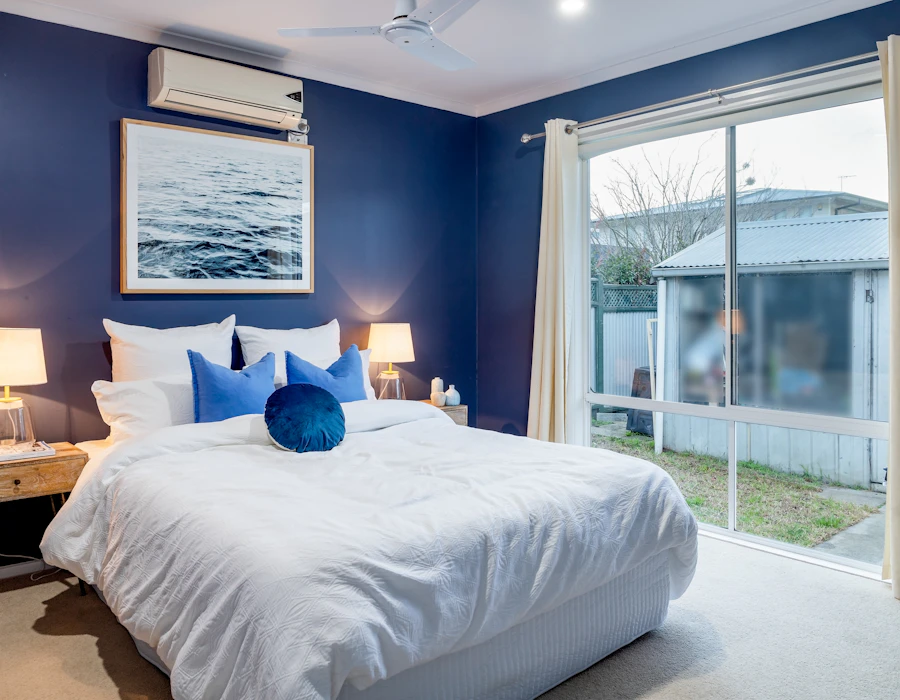
We most commonly install the indoor unit on the wall opposite the window or in a corner of the room, approximately twenty to thirty centimetres below the ceiling – this allows the air stream to spread across the entire room rather than blowing at one specific spot. In bedrooms, we aim to position the unit so that the airflow does not blow directly onto the bed, and in living rooms, we ensure it does not blow directly onto the sofa. We also avoid installing above a radiator or in close proximity to a heat source – otherwise, the unit would record a distorted temperature and regulate less effectively.