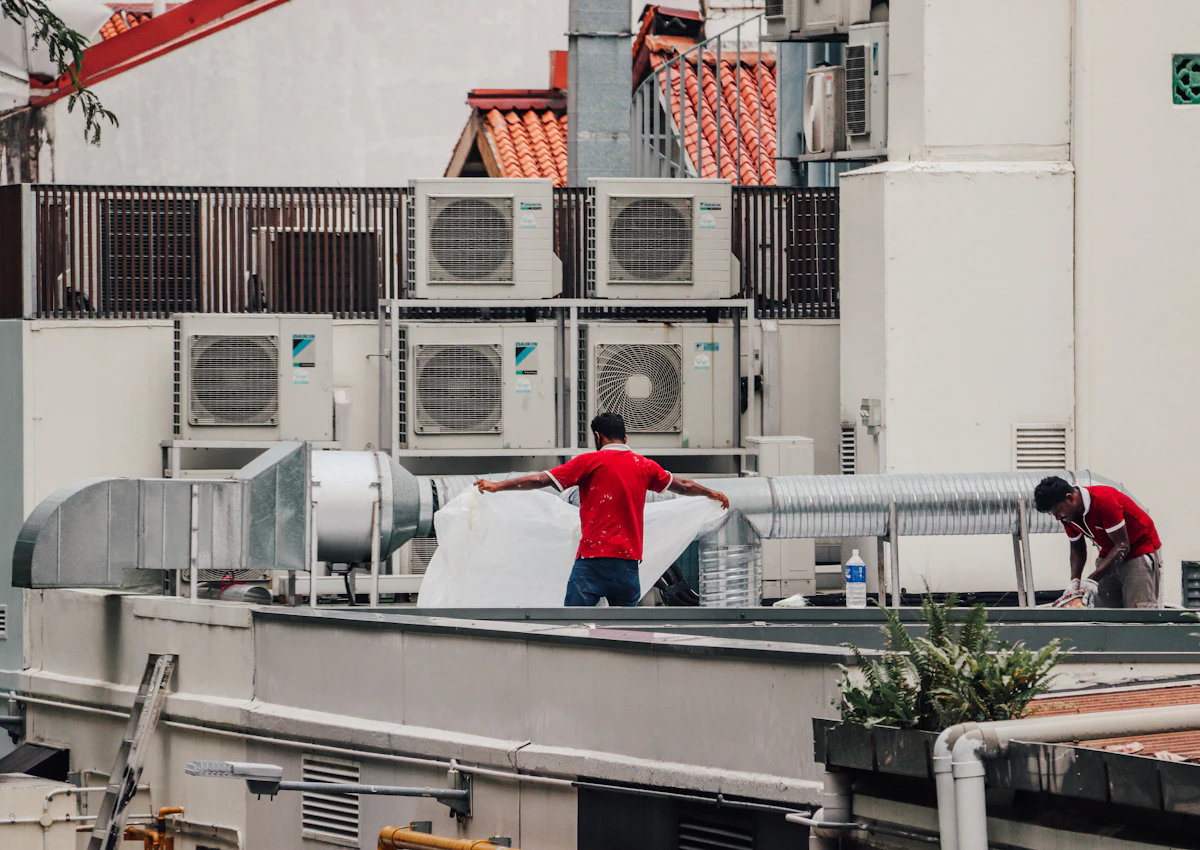
Air conditioning in Plzeň was previously mainly sought for summer use. However, in recent years, an increasing number of people from Doubravka and Lochotín, as well as those living in detached houses on the city outskirts, are also considering whether the same unit can assist with heating during winter. The answer is yes – modern air-to-air air conditioners operate bidirectionally as heat pumps, without any additional investment beyond the unit itself.
How an air conditioner works as a heat pump
The air-conditioning unit transfers heat from one space to another using refrigerant and a compressor. In summer, it extracts heat from the room air and expels it outdoors via the outdoor unit – this is standard cooling. In winter, the same circuit can operate in reverse: heat is drawn from the outside air, even when cold, and delivered into the room through the indoor unit. This principle is known as an air-to-air heat pump and is significantly more efficient than direct electric heaters or electric convectors, because it does not generate heat directly from electricity but moves it from the air.
When does it make sense to use air conditioning for heating as well?
- As supplementary heating during the shoulder seasons – in spring and autumn, when central heating is not yet or no longer running.
- In flats with electric heating, where air conditioning can replace more expensive direct heaters for part of the heating season.
- In a detached house as a supplement to the existing heat source in rooms where rapid heating is required – for example, in a home office or an attic.
- In outlets and offices where the unit runs year-round for cooling and ventilation.
Where the limits lie
The efficiency of an air-to-air heat pump decreases as the outdoor temperature drops – during severe frost, the unit heats less effectively than in milder weather. Therefore, in our Plzeň area, air conditioning is usually not designed as the sole heating source for a house, but as a supplement to the main heating system. In new builds with underfloor heating or where the primary source is a gas boiler or another heat pump, air conditioning is better suited for quickly warming a specific room rather than replacing the entire system. We always discuss the design on-site according to the specific house or apartment.
Operation and servicing of units that both heat and cool
If you use your air conditioner for heating as well, this means practically year-round operation instead of just a few summer months. The unit therefore has more running hours per year, which also affects maintenance – the evaporator and filters clog up faster, so we recommend servicing once a year without exception, ideally in autumn before the start of the heating season. For the outdoor unit, it is necessary in winter to ensure it is not buried under snow or frozen solid – most modern units have their own defrost cycle, but it still pays to keep the area around the unit clear, especially for houses with higher snow cover in the vicinity of Plzeň.
Subsidies for heat pumps
There may be subsidy programmes available for heat pumps – we will advise whether any apply to your project and how to prepare the application. Exact conditions and support amounts change over time, so we prefer to verify specific figures during the current survey rather than providing data that might become outdated. An overview of how subsidies generally work for air conditioning as a heating source can also be found at on our homepage.
Before deciding on an air conditioner with heating function, it is worth clarifying the basic parameters of the unit – performance and type are discussed in the article. Which air conditioner for an apartment, installation price then in the article air conditioning installation in Plzeň.
It is not the same as an air-to-water heat pump.
Air-to-air air conditioning in heating mode must not be confused with an air-to-water heat pump, which heats water for standard radiators or underfloor heating and is typically connected to the entire house heating system. Air conditioning, on the other hand, heats the air directly in the room where the indoor unit is installed – it is a solution for specific rooms, not central heating for the whole house via the heating system. We will discuss together during the survey which approach makes sense for your house or flat.